NEC PC-88 Series (Emulators + Tools + Lists)
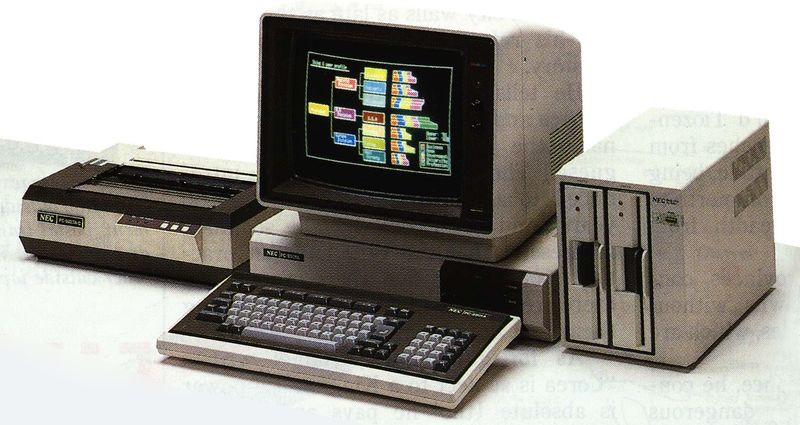
NEC PC-88
Page last updated on 24 March 2024.
- New builds for M88x, XM8 and Vaeg. Brand new XM8 port for macOs. New documentation links (PC88 Memorandum by hitchhikr.Find them by looking for the NEW mark here
Previous update: (01 August 2023)
The PC-88 was a line of Z80 based PCs released only in Japan by the NEC Corporation.
The first one of them, the PC-8801, was launched in 1981.
There were a lot of models for this line, a good and extensive summary can be found here here (archived version, main version now dead with Geocities Japan 🕇
).
An exhaustive catalogue of the games released for the system, along with other informations, can be found here on the excellent PC-88 Library, now again online. If you see garbled text, set the SHIFT-JIS encoding for the page in your browser.
The main OS for these machines was the BASIC (included with the PC
itself), but a very primitive version of MS-DOS and CP/M (the latter
supplied with the game Zork) were also available for use.
EMULATORS
M88: maybe the most used emulator for the PC-88. It’s open source and it’s the only emulator that supports CD emulation so far no longer true! Takeda Toshiya’s one emulates CD too (builds from 19 December 2018 onwards), and is able to run properly both the data and audio channel together even on mounted images.
-
- M88r2 (Build 2021-01-17) M88r2 is an upgrade to the classic M88, with English keyboard layout support, better FMGEN support and C86CTL (FM OPN3-L) support (but you will need the c86ctl.dll file inside the emulator directory, you can find the dll inside this Launchpad package).
- M88g (Build 2021-02-21) M88g, a new upgrade to the classic M88, with modernized source that can be used on modern compilers, support for FDX images (images created with FDX68, from X68000 computer line), FMGEN support and C86CTL (FM OPN3-L) support (but you will need the c86ctl.dll file inside the emulator directory, you can find the dll inside this Launchpad package).
- M88x6 build 2023-10-14 NEW New upgrade for this modded version of M88.
- M88x6 build 2023-04-03 Upgrade for this modded version of M88.
- M88x6 build 2022-07-24 Modded version of M88 with some neat features, like KegaFusion filters support, external sound dll support, patches and key macros.
- M88X5 (Build 2021-01-12) Upgrade to the M88X emulator (read below).
- M88X5 (Build 2020-11-23) Upgrade to the M88X emulator which is described below.
- M88X5 (Build 2020-08-14) (Partial English)An upgrade to the classic M88X build, it adds many features, like the possibility of enabling patches (via .PAT files) or FMGEN sound by adding the ‘FMGenDll=path to fmgen.dll‘ line in the M88x.ini file (which is automatically created in the .exe directory after the first run). The emulator, like the others, needs the ROM files properly placed in it’s directory to run correctly.
- M88 build 2022-05-05 New version of nenecchi’s version of M88.
- M88 build 2021-03-11 Upgrade (dated 11 march 2021) for the classic M88 by nenecchi, some improvements are: better resolution and zoom, improved imput sources.
- M88 with fmgen.dll build 2020-11-08 A new build (dated 08 november 2020) for the classic M88 by nenecchi, with it’s fmgen.dll file (to use it, add it’s path to the ini file that is generated after the first boot with the usual syntax FmGenDll=path).
- M88X Build 2.21a (Japanese language)
- M88 FM Gen Build 2.21a, 2019-06-04 (Japanese language)
- M88 2.21 (Japanese language)
- M88 2.21 (English language)
- M88 2.21 Source Code + CDIF files (needed for CD emulation)
- CDIF files (needed for CD emulation)
- M88 2.21 Debug version
- M88 2.21 Debug Source Code
- M88 2.21 Debug version
- M88 (unofficial build) 5 October 2011
This unofficial build improves the original M88 in many ways, adding a
lot of useful features like antialising, quick volume adjustment with
mousewheel and scaling options. Check it out. - M88 (unofficial build) 5 October 2011 with a preconfigured setup, addon modules, FDD seek sounds and utilities.
- M88 (unofficial build) 8 December 2011.
An upgrade to the M88 latest unofficial build. If you want to upgrade
from the previous version, it’s sufficient to replace the .exe file with
the new one contained in this archive.Also, this version of the emulator supports the MAME FM Module (click on the link to download). To enable it, edit M88.ini and add the following line: FMGenDll=mamefm.dll - M88 (unofficial build) 4 February 2012. An upgrade to the latest unofficial build. You need to add the ENHANCED=1 line in M88.ini file. Also, CPU speed is specified in Khz instead of Mhz.
- M88 (unofficial build) 20 November 2012 with a preconfigured setup, addon modules, FDD seek sounds, non ASPI CD drivers, patches and utilities.
- M88 (unofficial build) 14 May 2013 with a preconfigured setup, addon modules, FDD seek sounds, non ASPI CD drivers, patches and utilities.
- M88 (unofficial build enchanced edition) 21 September 2016 with a base preconfigured setup, FM DLL, non ASPI CD drivers.
- M88 (unofficial build) 2.21a 16 June 2017 with a base preconfigured setup and some help files in English.
- M88 23 Feb 2018 Unofficial build of 23 Feb 2018 (v 2.21a) kindly translated in English by Anna Wu.
- Documentation for the patch function present in the M88 unofficial build (in English). Contributed by Kobushi.
- Non Aspi CD drivers for M88 plus source code.
PC88 WIN: a very old and outdated emulator. However, it can be useful to run some games that M88 won’t run.
QUASI88: a very good, accurate and complete open source emulator with some great debug functions.It got ported on the PSP too. Unfortunately, it’s in Japanese only. To make it work, you must
put your BIOS files in the ROM folder and rename them in this way:
FONT.ROM = Font rom
N88.ROM = N88 Basic rom (32k)
N88KNJ1.ROM = Kanji 1 rom (128k)
N88KNJ2.ROM = Kanji 2 rom (128k)
N88SUB.ROM = Disk rom (2k or 8k)
Please note that the emulator is case sensitive.
New version for the Q88X emulator. It also support FMGEN sound by adding the ‘FMGenDll=path to fmgen.dll‘ line in the q88x.ini file (which is automatically created in the .exe directory after the first run).
- Q88X4 2021-01-22 Windows
- Q88X4 2020-11-23 Windows
- Q88X4 2020-08-14 Windows
- QUASI88 NOW AKA Q88X 2018-11-29 Windows
- QUASI88 0.6.3 SDL Win32
- QUASI88 0.6.3 Source Code
- QUASI88 0.6.3 for UNIX Source Code
- QUASI88 0.6.3 for MAC OS9 (classic)
Quasi88 is being ported on the Wii by jpzm. The port is still much in the works, but you can download it and follow the progresses on the project’s GitHub.
- Wii88 GitHub (version at 25 August 2017: 0.1.1)
J80: A Java based emulator focused on the 8001 series.It’s still in development, so check out the project’s site often! The archive contains the emulator plus all the tools listed on the site and a copy of the site’s page (in Japanese). I’ll update the archive along with the updates on the emulator’s main site.
88VA Eternal Grafx: An emulator for the 88VA model. To be able to save states, just add “Statsave=true” (minus the ” of course) somewhere in the INI file. A new option, named “Stat” will appear between “Replay” and “FDD1”
VAEGX: An emulator for the 88VA model, based on the 88VA Eternal Grafx one, with enchancements.
Upgrade for the Vaegx emulator, supports also FMGEN sound by adding the ‘FMGenDll=path to fmgen.dll‘ line in the vaegx5.ini file (which is automatically created in the .exe directory after the first run).
X88000: An open source emulator focused on the
emulation of the old PC-80xx models. It’s tape emulation is far better
than the one of M88 and it’s required to play some games.
- Project’s home page
- X88000 Now AKA X88X v 2.7 (Windows) Build 2023-06-25 An improvement over the standard X88000 emulator family. Latest Build.
- X88000 Now AKA X88X v 2.7 (Windows) Build 2021-01-22 An improvement over the standard X88000 emulator family.
- X88000 Now AKA X88X v 2.7 (Windows) Build 2020-11-23 An improvement over the standard X88000 emulator family.
- X88000 Now AKA X88X v 1.5.3 (Windows) An improvement over the standard X88000 emulator family
- X88000 1.5.3 (Windows)
- X88000 1.5.1 (Windows)
- X88000 1.5.1 source code (Windows)
- X88000 1.5.1 (Linux)
- X88000 1.5.1 source code (Linux)
- X88000 1.4.0
- X88000 1.4.0 Source Code
- X88000 1.4.0 for LINUX Source Code
- X88000 X3 with sound board 2 support (unofficial build)
- X88000 x88x12 with sound board 2 support (unofficial build)
XM8: A new open source emulator for PC8801MA written on the basis of the ePC-8801MA emulator written by Takeda Toshiya. Currently runs on Linux,Windows and Android.
- Project’s official page
- XM8 v 1.74 Build for all systems and architectures (including new MacOS port). NEW
- XM8 v 1.74 source Source code for v 1.74. NEW
- XM8 v 1.70 Build for all systems and architectures plus source code.
- XM8 v 1.61 Build for all systems and architectures plus source code.
Excite88: Another brand new emulator for the very first model of the PC8801, running on Windows (from 7 onwards). However, it’s still in infancy, according to the project’s page notes it runs only tape images in CM8 and T88 format and doesn’t support yet disk images, but it’s a feature that will be present in the future releases of the emulator. Check for updates often.
ePC-8001mkIISR, ePC-8201 and ePC-8801MA: A collection of new emulators by the brilliant mind of Takeda Toshiya, who is breathing some new life in the retro Japanese emulation scene. These three emulators are quite interesting and emulate the PC-8001mkIISR, PC-8201 and PC-8801MA series, like the names imply. In particular, the MA one is able to emulate the CD games too, being the second emulator able of doing so On the builds from 18 December 2018 onwards, CD emulation is fully supported both on the audio and data track. All of the emulators are for Windows and have both binaries and sources available to the general public, and come together bundled with a lot of other emulators written by Mr Toshiya. The development is also quite active, so I suggest to use Toshiya’s site as a main reference. I’ve uploaded here, for backup purposes, the last bundle of source and binaries.
- Takeda Toshiya home page
- ePC-8001mkIISR and ePC-8801MA page
- ePC-8201 page
- ePC-8801MA v 190312
- Modded version with Textractor support by Cybermind (source code included).
- Emulator bundle official page: common source project
- Emulator bundle sources backup (at 17 August 2020)
- Emulator bundle binaries backup (at 17 August 2020)
- Emulator bundle binaries backup (at 31 December 2019)
- Emulator bundle sources backup (at 31 December 2019)
- Emulator bundle binaries backup (at 03 November 2019)
- Emulator bundle sources backup (at 03 November 2019)
- Emulator bundle binaries backup (at 17 December 2018)
- Emulator bundle sources backup (at 17 December 2018)
PC88SR: One of the very first PC88 emulators ever
written, with a lot of nifty functions, like the patch function (which
ended up in a M88 unofficial build too). This one runs EXCLUSIVELY on
PC98.
- PC88SR (PC98)
- Documentation on the patch function (in Japanese). Thanks to Kobushi.
MESS: Standing for “Multiple Emulator Super System”,
this ambitious emulator aims to emulate properly a lot of different
systems and machines, even the NEC PC88. Since it’s in constant
development, i’ll just add the link to the project’s main page.
To run any of these emulator, you’ll need the BIOS files of the machine. I won’t supply them, so don’t ask.
TOOLS
D88 Manager: as the name implies, a manager for D88
images. Among the functions, you can protect/unprotect disk images and
split D88 files that contain multiple disk images.
D88 Slowinfo & D88 Viewer: Two D88 utilities
released by Peter_J. As the name imply, they are tools for analyzing,
extracting and editing data on and from .d88 disk images. Instruction
and help files are inside the archive.
XDISK: another disk images manager. It supports 88VA images too.
- XDisk (+ source code)
- XDisk v3 (XDisk port for Unix systems) by bferguson3: GitHub,backup 2021-09-07
PC88-C: A minimal framework for PC88 development using C by bfergurson3
- PC88-C: GitHub,backup 2021-09-07 (v 0.1.2)
D88EDJ – D88 Editor for Java -: like the name implies, it’s a Java jar to extract and work with D88 images, available both to command line and GUI usage. It originally can be found here and was released back in 2004. Quoting the (translated) text that comes with the original page: Currently, it is possible to list the disk images inside the D88 file, divide it into a single file, switch write protection ON / OFF, and rename the disk name.
Also, only when the disk format is N88 DiskBasic, PC-8001 MicroDiskBasic, Magical-DOS, or Frost-DOS, you can display the list of files inside the disk and expand the files.
A data dump function has been added as an extra.
- D88EDJ ver 0.05
- D88File.class SDK SDK for the D88 file format used within the program.
- Documentation Translated text from the page, documenting the tool’s usage and details.
2D Tools Set: A tool set released back in 1998 (!!) for dealing with D88 operations on a PC98 machine. A typical usage would be to convert the D88 image to .2D format with 2d88, and then extract the files with pick2d. It’s original web source page is here.
Tools included, according to the (translated) text of the page:
2d88: Convert between D88 and 2D files
binadj: Removes headers from DISK-BASIC machine language files
d88disp: Displays sector information of D88 (this is not related to 2D image, but temporarily ^^;)
pick2d: Extract a file as a DOS file from a DISK-BASIC image
store2d: Save (?) a DOS file to a 2D image
wipe2d: Clear unused area of 2D image
- 2D Tools Set
- Documentation Translated text from the page. Unfortunately, not much more is to be written there.
FMGEN DLL
FM Gen X DLL: DLL file for the latest FM-GEN audio drive. You can use it with different emulators, (M88X,Q88X and VAEGX) by adding the proper value in the emulator’s ini file.
TECHNICAL INFO
D88 FILE FORMAT SPECIFICATIONS: A copy of the amazing work done by Ashura. It documents the structure of a proper D88 file in detail. Ashura worked over a Japanese document that can be found here.
- D88 Format Documentation
- PC88 Memorandum (external link) A great compilation of technical information about the whole PC-8801 line. NEW
COLLECTIONS
Here is a list of my PC-88 collections. I’ve divided it in several
.txt files. Please remember that you will need to be able to read
japanese characters in your text editor in order to read them properly.
- Peter J Pack A pack containing games, softwares and a lot of documents and extras. All the file names are in western characters. txt version (old)
- Newimg Share A collection of recently dumped PC-80 images. txt version (old)
- PC88 1240 Set A set of 1240 disk images. Japanese characters only. txt version (old)
- PC88 2220 Set A set of 2220 disk images. txt version (old)
- PC88 1840 Set A set of 1840 disk images. txt version (old)
- PC88 Megapack A set of various stuff. A lot of names are in Japanese characters, others are in western characters but with shortened names. txt version (old)
- 88 Soft Collection A huge collection of PC-80 and PC-88 games and software. txt version (old)
- Romanized set A big collection of games that have got their names fully romanized. txt version (old)
- TOSEC Sets + DATs The most recent TOSEC set with DAT files txt version (old)
- PC80 Collection A collection of PC80 stuff. txt version (old)
- CD Games Collection CD games that I own txt version (old)
- Old Tape Games Brought to Floppies Collection A set of D88 images, each filled with old tape games. txt version (old)
- Four more games Four more PC-88 games, some of them brought from tape to disk. txt version (old)
- PC88 Game Library (html version). It’s the most complete PC88 catalogue so far. Japanese language. txt version (old)
- PC88 Game Library (ISO version). It’s the most complete PC88 catalogue so far, collected on a single and nice CD. Japanese language. txt version (old)
- Neo Kobe and other new stuff. A list of new packs, games, utilities and other PC-80 and PC-88 related material that I’ve found across the net. txt version (old)
- Neo Kobe – NEC PC-8001 (2016-02-25). Complete listing for the latest PC-8001 set by the excellent Neo Kobe group. This, for now, has to be considered the best pack available around. txt version.
- Neo Kobe – NEC PC-8801 (2016-02-25). Complete listing for the latest PC-8801 set by the excellent Neo Kobe group. This, for now, like it’s 8001 companion, has to be considered the best pack available around. txt version.