Devilman
DEVILMAN

Index
Part I: Introduction; History, plot and a general review (no spoilers)
Part II: Comment and Interpretation (spoilers)
Part III: Other appearances in mangas and videogames (updated on 4 January 2019)
News 4 January 2019: After a long time (more than 6 years!) I’ve updated the third part of this article. Check it out!
INTRODUCTION
I’m very pleased to begin the comic/manga section of the site with an article on Devilman…certainly my favourite comic ever.
I came across it a long time ago, and it immediately struck me
deeply. At that time I couldn’t understand all of it, but the strong
emotion and fascination I felt nested inside me and grew inside me over
the years. When I read it again during the years, bit after bit a
picture formed. I finally could rationalise and put into words the
strange emotions and feelings that I’ve already felt in the past.
Very few comics struck me so deeply…among others (for example Moore’s
V for Vendetta and Tezuka’s Blackjack and Buddha) are all masterpieces
in the same league as Devilman.
Therefore, it’s appropriate to me to inaugurate this section with a big article on the devilman…I hope you will enjoy it.
HISTORY, PLOT AND A GENERAL REVIEW (NO SPOILERS)
Devilman was written by the Japanese author Go Nagai in 1972, shortly
after the demise of Mao Dante, which was closed abruptly because of
it’s extreme and shocking content in 1971.
Devilman picks a lot of themes from Mao Dante, but it develops them in a
very different way and with a different perspective. As Nagai himself
tells, Devilman started as a project for an anime serie (which was
indeed created and had a 39 episodes run), heavily inspired from the
tokusatsu (Japanese super heroes, like the infamous Kamen Rider or
Ultraman). Nagai worked at the same time on the anime serie and on the
manga, but the two projects were very different from the start, in all
the aspects: plot, mood, style, objectives.
Nagai in his memories recalls that writing Devilman was a very exausting
work, a work which absorbed him fully and in some way made him work in a
sort of trance-like state. It’s not hard to believe him: Devilman is a
very intense work, and this intensity oozes both in the story and in the
realization: the graphic style is nervous, expressionist-like,
essential but rich in emotional overtones: visage are molded by the fire
of the emotions; anathomies are situated in a strange world between the
human and the demonic one; shadows and lights dance and mix themselves
in a swirling, and extremely fascinating chaos. This is probably the
best graphic work of the early Go Nagai. The plot, on the other hand,
has a spiral-like pattern: it starts out pretty “normal” (if this word
is suitable to any of the Nagai’s works) only to slowly sink deeper and
deeper into the macabre, the bizzarre, the absurd and then, once there,
it starts spinning faster and faster, forcing the reader to follow it’s
strange tides, until the very center of the spiral of chaos. The descent
into the realms of the irrational can be found in more or less all the
best works by Nagai, but Deviman maybe is the one in which this works
better and it’s more spontaneous. Nagai in his memories recalls that he
himself often didn’t know how the situations would turn later and he
states that he didn’t knew fully about the demise of his characters
while writing Devilman.
I’ve collected the part of Nagai memories (in the form of nice comic
pages) regarding Devilman here on the site. Check the third section of
the article (other appaerances) to find the download link.Be careful,
because they are full of spoilers, so I suggest reading them after
having read the manga.
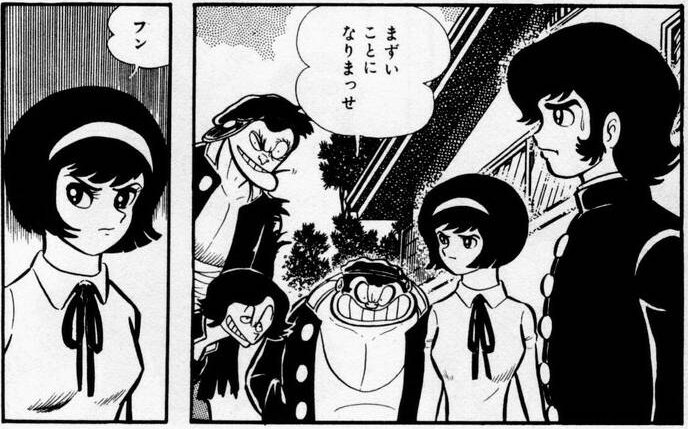
Akira and Miki, at the very beginning of the story
Having said that, let’s examine a bit of the main plot. The comic
revolves around Akira Fudo, a shy and kind-hearted high school student.
He is a good guy, but he is also pretty weak: he refuses conflicts and
violence on a level so deep that he finds himself to be a victim of
conflicts and violence, thus paradoxically failing in his effort of
avoiding them because of his very own avoidance. One day, his best
friend, Ryo Asuka, a blond and cool guy wearing a trench, summons Akira
in his mansion. Something terrible has happened…Ryo’s father, an
important archeologist, has slowly gone mad, turning into a violent and
possessed man, and finally after a painful descent into madness killed
himself by burning himself to death, after making an important
archeological discovery, a strange demon mask older than the human race
itself.
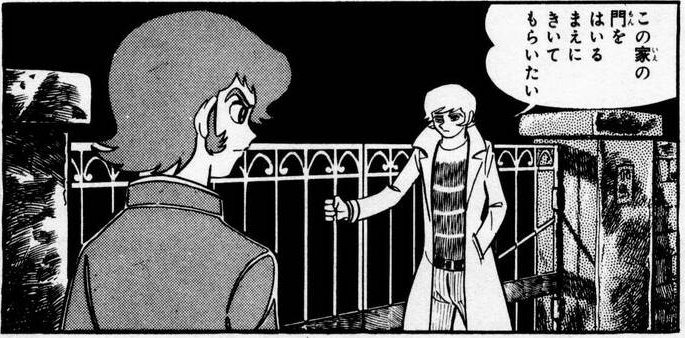
The mysterious Ryo Asuka
The mask bears a secret in it’s insides: who wears it has a vision of
the world of the demons, that ruled the Earth before the coming of man.
The mask thus is an equivalent of the human history books, some kind of
book for a race that didn’t write but communicated telepathically.
Ryo tells Akira to wear the mask, and he do so, thus seeing the ancient
demon world. However, Ryo says, the demons are not dead and are
preparing to walk the earth once more. The demons are not powerless
either: humans have technology and science on their side, but demons
have big supernatural powers: in particular the ability to fuse with
other living organisms. Ryo and Akira are then attacked by a demon and
so after a quick escape, Ryo brings Akira to a basement and explains his
secret plan to him.
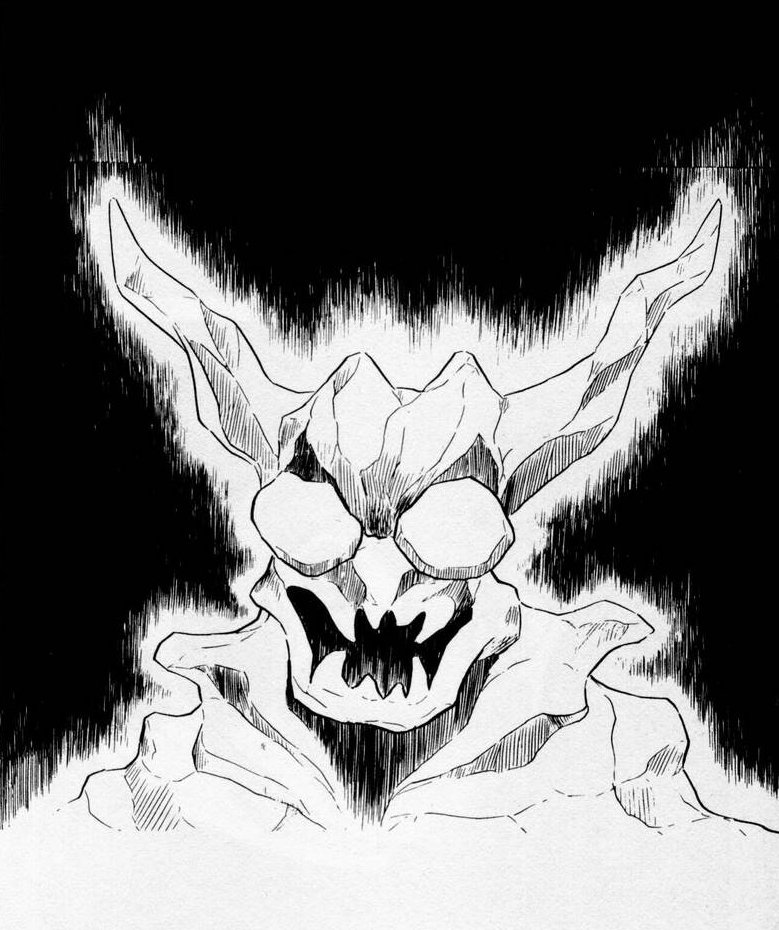
The ancient demon mask
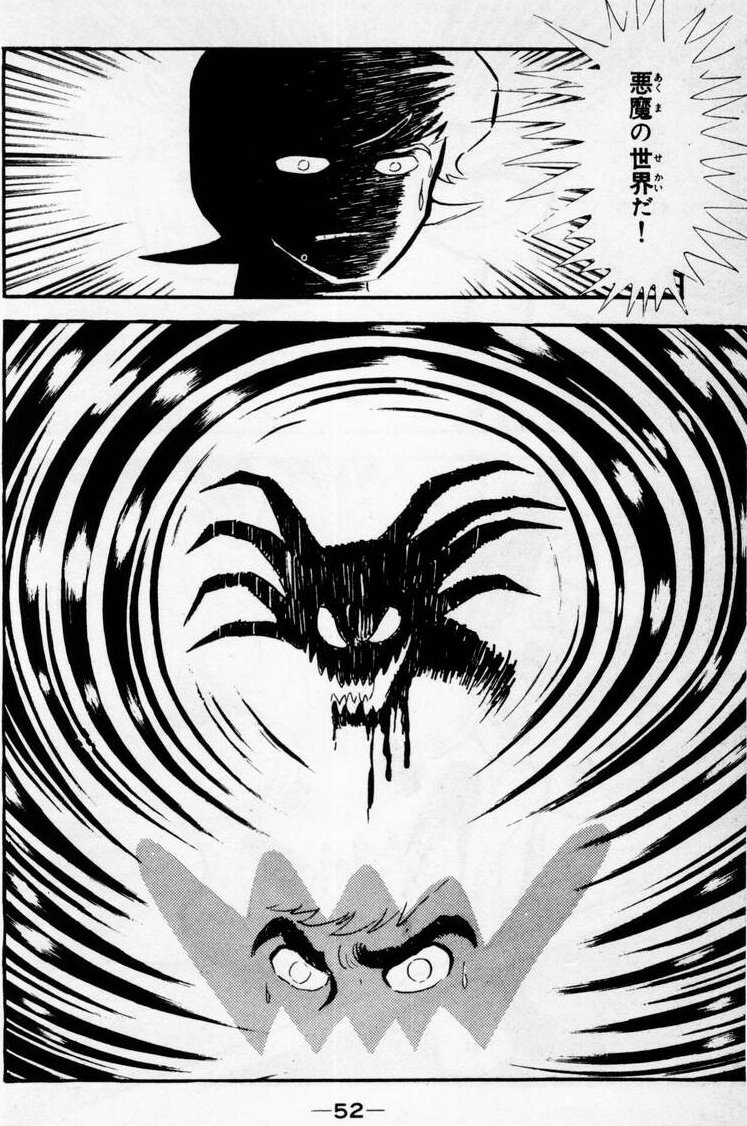
Morbid visions from an ancient past. “Akuma no sekaida!” “This is the world of the devil”
Ryo’s father tried to study and understand the nature of the demons
by fusing with one of them, a demon that slowly took control of his mind
making him mad. With a last spark of humanity, Ryo’s father decided to
suicide in order to avoid to become fully a monster.
The only way to counter succesfully the attack of the demons is to fuse
with them but without being controlled by them: to become a Devilman, a
human’s heart nested into a demon’s body.
The two thus decide to try to do so. Ryo has organized a big chaotic
party in the basement: demons like chaos, irrationality and are more
inclined to fuse with humans under these conditions.
The chaotic party, similar to an antique Bacchanal, soon turns into a
bloodfest: demons like violence too, and so Ryo starts a riot by slicing
some people with an empty bottle. Soon demons start to fuse with the
humans, but not with Ryo and Akira. When all seems lost, Akira mind
shatters in pure terror and only then a demon fuses with him. The demon
in one of the strongest and so easily disposes of the other demons…Akira
has succesfully become a Devilman. Ryo is the only not-possessed human
survivor of the slaughter. And so the adventures of Devilman and it’s
strife against the demon race begins. This more or less summaries the
first volume (of five) of the manga.

Ryo’s father bursts into flames

The birth of Devilman!
As you may guess reading this, this work is heavily psychological.
The manga focuses a lot on this aspect, which is central both in the
facts and in their developement. Also, coherently, the work takes a lot
of material from ancient legends, myths and Christian religion and uses
it in a very personal and unique way to convey it’s story and message.
The main themes are two central ideas that can be found in most of the
successive work by Go Nagai: the impossibility of clearly separating
“good” from “bad”, both in their outer manifestation and in their deep
effects. Akira, like all the nagaian heroes, learns that in order to
achieve the “good” he must first accept and know deeply the “bad” inside
himself, which once integrated it becomes the source of physical and
spiritual strenght: after fusing with the demon, he indeed manage to
flourish it’s hidden talents, which were hidden in his defects: so his
shyness becomes strenght and ability to deal efficently with the outer
reality without losing oneself; his radical refuse of violence of
strenght transforms into a wise use of it, and so on. This is a very big
psychological truth, that can be found both in all of the major works
by the great psychoanalysts of the past (for example Jung’s Shadow
archetype and Otto Rank’s will therapy) and in the ancient eastern
philosophies and spiritual traditions (for example Zen, Buddhism, The
Hagakure; Taoism; Confucianism and so on). Everything has it’s contrary
hidden deep in itself, nothing is strictly black or white: thus
estabilishing a strict dualism, which strongly denies the “other” leads
only to disaster, inner and outer; individual and collective. We can
thus use this as a key to interpret what the symbol of the demon means
in this work, but I will do it later, in the second part of the article.
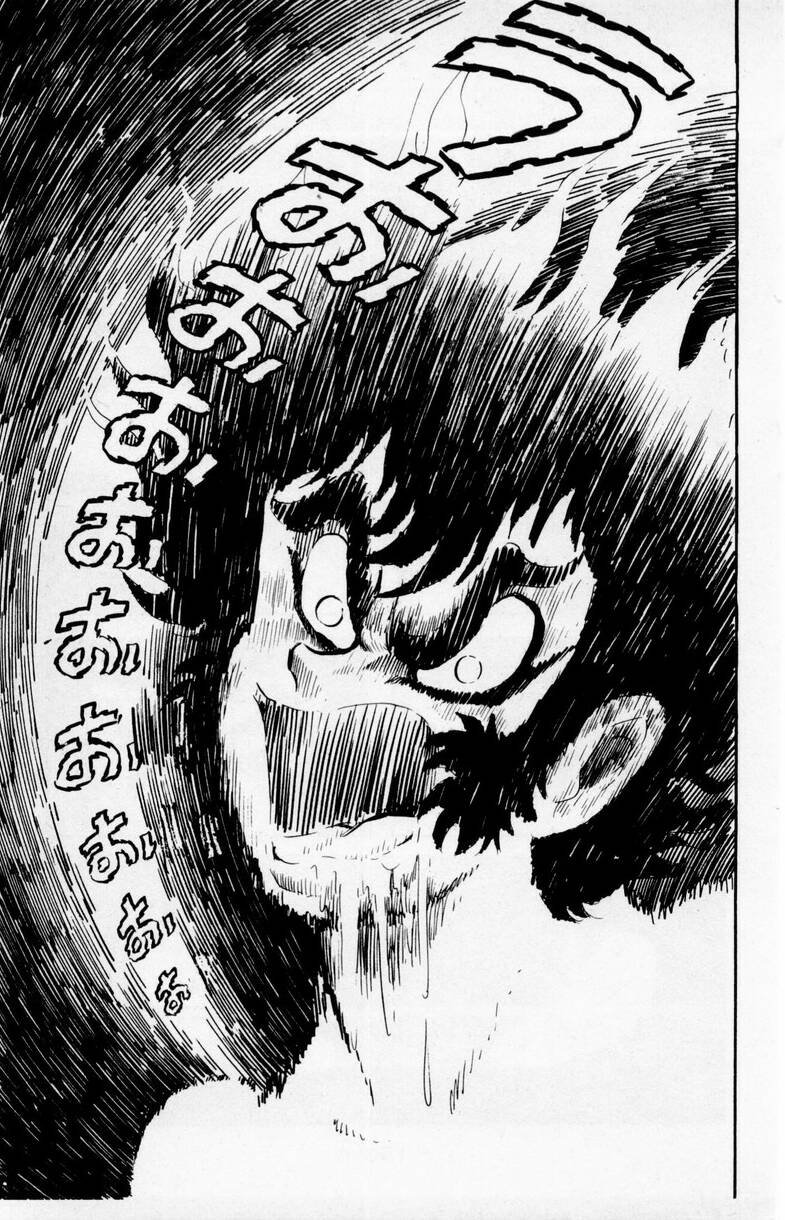
Mind shatters
The other important central theme is the sudden irruption of the
irrational, the absurd, – in one word – of Chaos into the reality of
everyday, a reality that may look calm, peaceful and tranquil on the
surface but hides raging storms and cracking thunders in it’s deep
recesses. However, as we saw earlier, these two apparently conflicting
dimensions are not alien to each other, but in some way they complete
and mirror each other. Things are not what they appear to be; the sudden
invasion of Chaos shatters all the firm and strong ideas on which the
common people clinged themselves to. How they will face that, when the
cover is finally removed from the heart of the abyss that always lied
nested deep in the reality of everyday? This is a very fascinating
question, and Devilman responds to it in a very original and
tought-provoking way.
Nagai in his recent comic-autobiography (different from the pages
I’ve posted here on the site), Gekiman, has connected Devilman to his
conception of war: this is certainly true, but on a bigger plane than
the simple military conflict. In fact, Devilman tells the tale of a war,
the war of humanity with itself, in a big denial process as Freud would
tell: the strife against all the denied side of the human mind of
emotion. Guilt, anger, anxiety, hate, scorn, unsatisfaction, fear but
also hopes, will of change, strenght. This is the cauldron from which
Chaos emerges into the world.
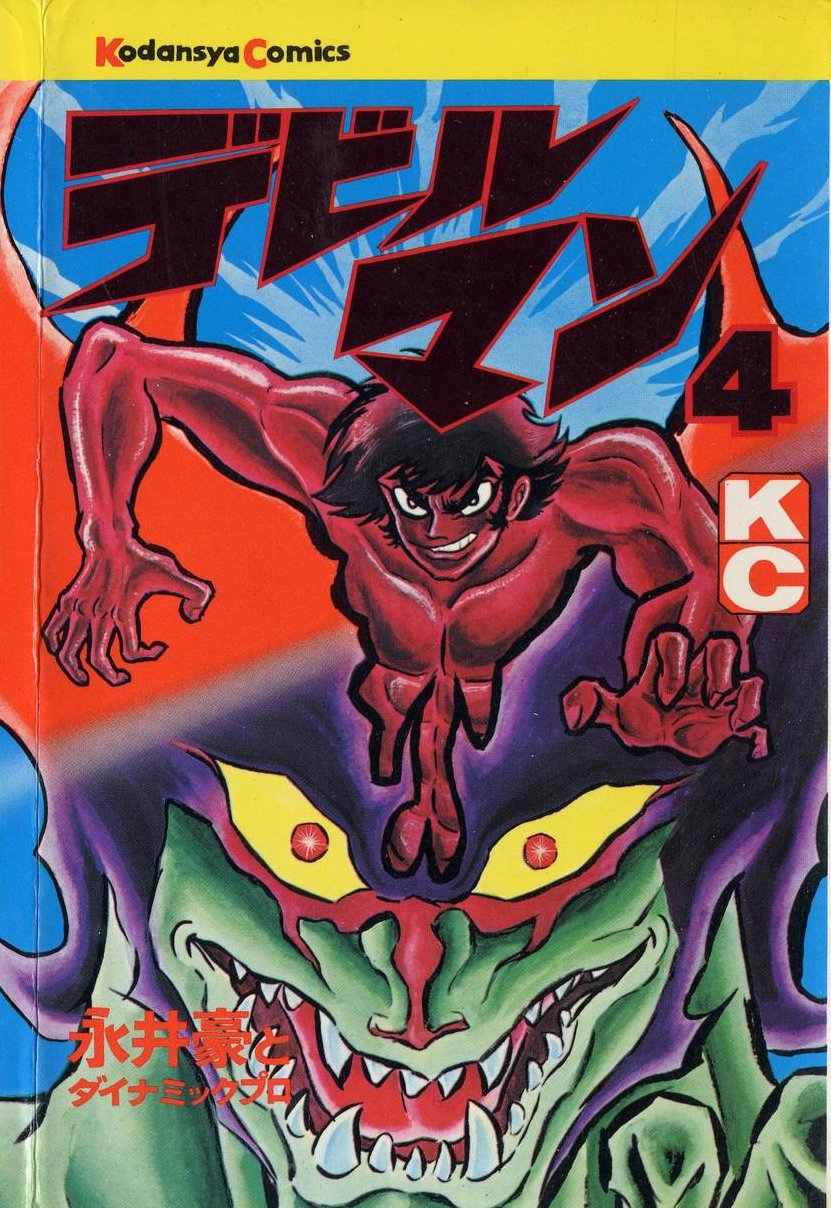
This manga, as you can guess, changed the world of comics forever.
The influence it had both in Japan and in the West was and still is
immense, and surely it’s a milestone. In nearly forty years from it’s
publication it hasn’t aged a bit and is still a work of immense
strenght, insight and cleverness. Definitevely a must read, indeed.
If you have read the manga and want to read my complete
interpretation for it, proceed to the second part of the article. If you
want to avoid spoilers, jump directly to the third part of the article.